A blog about problems in the field of psychology and attempts to fix them.

Sunday, January 2, 2022

Abduction and the myth of introspection


First question from most people: What the heck is abduction? 

There are many answers to that question. 

My preferred (at the moment): Abduction is that it's that thing scientists do that definitely isn't deduction or induction, but which has been mindbogglingly successful over the last few hundred years.

Nick's preferred answer, and figure 1 in the paper: 


That's a teaser, and here is the abstract: 
Much of the history of psychology can be understood as a debate over what we do when we attribute psychological states to ourselves and to others. In the classic Cartesian view, those activities are quite distinct: We engage an infallible ability—introspection—when examining our own psychological states, but merely speculate when trying to identify the psychological states of others. The American Philosopher, Charles Sanders Peirce dedicated several early papers to a critique of the Cartesian approach. He concluded that attempts at self-knowledge require the same inferential processes that we use when attributing mental states to others, and therefore incur the same logical risks. By pursing these ideas further, we intend to show that self-knowledge results from a special kind of abduction; the inference of behavior states from particular observed behaviors. Such inferences allow us to anticipate yet-unseen patterns of behavior in yet-to-be-manifested circumstances.

Full text available on ResearchGate: (PDF) Abductive Inference, Self-Knowledge, and the Myth of Introspection (researchgate.net)

Friday, October 29, 2021

Deep thoughts: P Zombie Couches


I wrote several years ago about the classic "Stomach in a Jar" problem that has vexed philosophers for decades. I write today about the equally complex Philosophical Zombie Couch problem, which has fascinated philosophers since Keith Campbell and Robert Kirk introduced the idea in the early 1970s, and David Chalmers popularized it in the mid 1990s. Many of you will not be familiar with the problem, so let me lay it out simply to start out with. 

You could summarize the argument with a single premise: We can all imagine an object with all the properties of a couch, but which does not contain couchishness. 

Sunday, March 21, 2021

Veridical Perception (In Verse)

 The APA Journal History of Psychology started a News an Notes section a few years ago, including a "Poetry Corner." Most contributions are archival finds of poems by historically-eminent psychologists, but they also invited poems about the history of psychology. So far as I know, I am the only person to take them up on the latter offer. This was my first contribution:

Veridical Perception

Debate about whether perception can ever be veridical – true to reality, accurate with respect to the world – holds an important place in the history of psychology, driving both theory and research. Due to Descartes’s legacy, most early psychologists took for granted that perception was always indirect, and therefore inherently inaccurate. An alternative tradition began maturing in the final phase of William James’s career, but it’s implications for perception were not developed significantly until nearly half-a-century later, when James J. Gibson developed his system that showed how direct perception was possible. This re-enlivened the debate for several decades, though Gibson’s key points in the debate, the key features of the resulting research programs, and much of the crucial terminology, remains poorly understood. Nevertheless, the work of James and Eleanor Gibson inspired a field, Ecological Psychology, which endures, focusing on perception-action cycles, particularly in situations where veridical perception can be, and often is, achieved. Harry Heft, Ed Reed, Alan Costall,  Robert Shaw, and Joel Michell are among the psychologists who have explored the history of this work.

A. A. Milne is now best known as the author of the Winnie the Pooh book, but was quite well reputed before that for his plays and his poetry, including collections such as “When We Were Very Young.” The style of “Veridical Perception” will be familiar to any who have read his work.


Veridical Perception

Passive sensations, from watching or hearing,

Sensations of those types are often quite strange,

But active perception, like looking or feeling,

Perceptions of those types one might well explain.


For all is,

Uncertain,

When sitting back,

Passively,

Sight is,

Uncertain,

When cast to a plain.

The world,

Impinges,

(Impinges, impinges).

“The world,

Impinges,”

The dualist exclaims.


Darwin, he changed this, with his focus on function,

A focus on function, James would soon mend,

The field, Psychology, from backwater drudgery,

But Watson derailed it, ‘fore his Hopkins upend.


James,

Had inspired,

As Radical,

Empiricist,

New Realists,

Who emerged,

And captured the stage.

But only,

In philosophy,

(Philosophy, philosophy).

Some stayed,

At Harvard,

Holt retired to Maine.


Holt was self-exiled, when Langfeld retrieved him,

To a decade at Princeton, where little was said.

But Gibson, his student, was there much inspired.

And therefore the realism continued to spread.


Gibson,

Studied prisms,

Which flipped,

Around visions.

His reputation,

Hinged,

On the curving of lines.

Then war came,

And flying,

(By pilots, in airplanes),

Took him,

To question,

Psychophysic’s hard line.


Just-noticed differences, had little merit,

When trying to determine who could land a plane.

Movement and motion resolved ambiguity,

And all this transpired outside of the brain.


Meanwhile,

Jackie,

At Yale,

Rejected,

by Yerkes.

For “there are,

No women in my lab.”

Finds Hull,

Grand planning,

(With symbol, equations).

Discrim-ination,

Becomes hers to divine.


Discrimination, perceptual learning,

Distinguishing things, out there and in hand,

Humans with flash cards, but no reinforcement,

Still there’s improvement, Law-of-Effect be damned.


Improving,

Responses,

To “out there”,

Reality.

Requires,

Responding,

‘T out there - not ‘n mind.

But what of,

Reality?

(Reality, reality)

Di-rect,

Perception,

Still sounds like,

a line.


Back at Smith college, Jimmy and Jackie,

Restless, but not, too eager to leave,

Hoping for Cor-nell, which soon comes a calling,

And the Seer of Ithaca’s, sabbatical reprieve.


Deeply,

Rethinking,

Fundamental,

Assumptions.

Retinal flow,

Not enough,

With evolution in mind.

Adaptation,

To the world,

(Ecology, Ecology).

A brand new,

Ecology,

Must now be defined.


Ecological optics, the light that surrounds us,

Converging at points, where our eyes can reside,

Then even the insects, and primitive crustacea,

Adapt ‘t the same structure, with quite different eyes.


The Senses,

Considered,

As Perceptual,

Systems.

Eyes in head,

In a body,

Exploring to find,

Higher-order,

invariants

(invariants, invariants).

Lawful,

Relations,

Which can specify!


Systems designed through evolution and developed,

Embodied and enactive, and fully alive.

Attuned to possibility, opportunity, of behavior.

Attuned to affordances, so the animal can thrive.


But we,

Most surely,

Are not,

Always perfect.

Not long,

Without error,

The critics complained.

But focus,

On success,

(In action, in action).

Accuracy,

Is the thing,

Perception explains. 


Speci-fication, is the crux of the argument.

How’s an organism accurate, in the best of times?

Perceptual attunement, makes action a function,

Of invariants that specify, the world’s confines.


With error,

It matters,

What kind,

Of a system,

Has failed,

In pursing,

That towards which it strives.

Not coherence, nor

Cor’spondence,

(from world, to ideas).

A Convergence system

Finds truth,

Given time.


Peirce’s legacy stretches, to James and Holt realism,

Nothing is added, by mental design.

Behavior’s a function, of out-there, world-happenings,

And part of the “out there”, James Gibson defined.


Veridical,

Perception,

Accurate,

Functional.

No magic,

No ghost soul,

No dualist’s,

refrain.

The truth of,

The matter

(The matter, the matter)

The truth of the matter can really be plain.


------------------------

 Charles, E. P. (2018) Veridical Perception. History of Psychology 21, 172-175.


Monday, March 1, 2021

Defining key terms in Ecological Psychology

Andrew Wilson and I had a tiff on twitter about whether "Affordances" are by-definition "perceivable". Well... backing up... it was a tiff about whether it is fair for a researcher to start talking about something as an example of an affordance, when they have not bothering to demonstrate that the thing in question is perceived. This actually has deep implications for all the key terms in Ecological Psychology. As it is the type of thing you can't really discuss in 240 characters, we decided to return to the blogosphere. Who knows, maybe we can crank out a second blog-driven co-publication when this is done!*

I am extremely sensitive to the problems that occur in a theory when terms start to get mutually inter-defined. You quickly end up with tautologies, and tautologies stop your theory from being a theory in any proper sense. My post-doc advisor and occasional co-author Nick Thompson wrote about this problem extensively in the context of learning theory and evolutionary theory and other contexts in psychology. I don't think any prominent members of the Eco Psych community have such a problem when they are doing research. However, when they start writing theory, the problem pops up fairly often, and it is behind many of the long-term disputes in the literature. The temptation to inter-define terms is strong, because when terms are mutually defined, deduction is easier, and that makes the theory feel intellectually safe and well-founded. However, that feeling is misleading in a scientific context. you can't test things that are deducible from each other, so if you find yourself just stating things that are true by definition, you don't have a theory anymore, because the exact part this is supposed to be testable can't be tested. The way out of this is to rigorously ensure that your terms point to things that can be verified independently of each other, leaving it open for testing whether the things in question relate in the manner proposed. 

Friday, January 10, 2020

The Ecological Revolution: The Senses Considered as Perceptual Systems, 50 Years Later

In 1997, the journal Ecological Psychology published two issues in tribute to James Gibson's The Senses Considered as Perceptual Systems, which was published in 1966. I am creating this page as a landing pad for my posts regarding the articles in those issues. I will also add links, as I find them, to other places on the internet where these issues are discussed (suggestions in the comments are strongly encouraged). I reviewed a few of the articles when they first came out, but recently found the issues again and realized how negligent I have been in covering more of them. One special treat about those issues is that they feature articles by several of my favorite contributors to the field, and the quality of the articles is very high.

Sunday, October 6, 2019

How we got to the muddle of "The Hard Problem" in psychology


Once upon a time we knew almost nothing about how vision worked, then, at just about the same time, all of the following happened:
  1. Artists figured out perspectival drawing, and people went nuts over it.
  2. It was discovered that they eye of a bull could act like a “camera obscura.” Camera obscuras were small dark rooms in the middle of a garden, built so that they cast an inverted view of the garden in one wall, by virtue of a pinhole in the opposite wall. Those were all the rage, because rich creepers could jerk off in them while spying on the ladies walking the garden. At that point, everyone assumed that vision was this passive thing that started with a still image in the back of the eye, and involved the opposite of whatever intellectual activity artists engaged in when creating a flat picture.

Friday, June 1, 2018

Chicago APA Convention 2019 - Society for the History of Psychology

FYI: Cathy Faye, President-Elect of the Society for the History of Psychology (American Psychological Association Division 26), asked a while ago if I would be program chair for the 2019 APA convention in Chicago. I foolishly agreed pretty readily! Three quick things:

1) If you or someone you know might be interested in being the co-chair, with me shouldering most of the work, please give me a heads up.

2) This weekend (June 1-3, 2018) I will be attending a training event for program chairs in Washington DC. The most obvious goal of this event is to help the program chairs figure out APA's convoluted process to create "Collaborative Programing." That has such a long timeline, it requires multiple divisions to join forces over a year ahead of the conference. I will post details here as I get them, but in the meantime, if you might have ideas for collaborative programs, or have interest in putting together a regular session for the 2019 conference, give me a heads up.

3) Cathy's presidential theme hasn't officially been announced yet, but she strongly shares my interest historic research that provide practical guidance for emerging issues in the field. So we will be looking for both straightforward history of psychology papers and historic critiques of currently emerging issues.


Sunday, April 8, 2018

Representation, Bee Dances, and Daniel Hutto

Dan Hutto, who does great philosophy of psychology work, recently gave an ENSO seminar titled Beyond Content: Explications, Motivations and Implications


This is the ENactive Seminars Online (ENSO), put together by Merek McGann and Mathew Egbert. Dan gives a solid overview of the players working today on whether cognition necessarily entails representation - and what on earth that might mean. For those who don't know, after championing a Wittgensteinian view of folk-psychology theories in the beginning of his career,  Dan has spent the last decade or so as one of the heavy hitters in philosophy arguing that cognition need not entail mental representation. Though he thinks representation has a place in the conversation - post language - he does not think "basic cognition" requires it at all.

Saturday, December 16, 2017

Perceiving sociocultural phenomena


This is the third in a series of posts examining the Special Issues of the journal “Ecological Psychology” commemorating the 50th anniversary of “The Senses Considered As Perceptual Systems.”

Harry Heft brings his unique insights regarding the history of psychology to bear, with a focus on the relatively-understudied implications of Gibson’s work for understanding culture. Recall that part of Gibson’s challenge to the field (see Shaw 2002) was to see how much could be covered by perceptual processes, and avoid the temptation to start hand waving at higher-level processes whenever the going got tough. One aspect of Gibson’s work, comparatively neglected by both his proponents and his critics, is his attempt to see how far he could push perceptual theory towards explaining the interaction of people in situations where cultural practice plays a strong role in determining what the world affords. As usual, Heft’s writing is clear and keen. If you haven’t read any of his work before, I suspect you will find this article deeply insightful, and that it will lead you to seek out more of his work.

Wednesday, December 6, 2017

50 Years of Research into Haptic Perception

Gibson’s 1966 book The Senses Considered as Perceptual Systems recently turned 50. Two issues of the journal Ecological Psychology commemorated that event (here, and here). This is the third in a series of posts reviewing those contributions. It covers Carello & Turvey's Useful Dimensions of Haptic Perception: 50 Years After The Senses Considered as Perceptual Systems.

Haptic perception is extremely neglected relative to visual and auditory perception. The term could refer simply to feeling things by touch, but in the context of EcoPsych is more likely to refer to perception as the result of manipulating objects, i.e., picking things up and moving them around. The Senses Considered included chapters about the haptic system, but offered only a cursorily outline of what an improved study of the haptic system would look like. Some the first wave of Gibson-inspired researchers latched onto those chapters, and created some of the more notable research triumphs of the field. Carello and Turvey performed, or supervised people who were performing, much of that work. Given that several good summaries of the research exist, they choose to focus instead on showing how the haptic research has been a uniquely suited context for exploring the novel implications of an ecological approach to perception.

Wednesday, November 22, 2017

Modularity and the study of visual perception - Marr and Gibson

Gibson’s 1966 book The Senses Considered as Perceptual Systems recently turned 50. Two issues of the journal Ecological Psychology commemorated that event (here, and here). This is the second in a series of posts reviewing those contributions.

Vision research was impacted tremendously by the short career of David Marr. Marr was tremendously impacted by James J. Gibson, though mostly by Gibson's earlier work on optic flow, and not by his later works that birthed Ecological Psychology. Marr was incredibly influential in the move towards thinking of vision (and neuroscience in general) as "modular", while most of Gibson's work would lead one away from modular thinking. It is this tension that motivates Sedgwick and Gillam's article "A Non-Modular Approach to Visual Space Perception."

Tuesday, November 14, 2017

The senses re-considered as perceptual systems - Introduction to the Special Isuses


Gibson’s 1966 book The Senses Considered as Perceptual Systems recently turned 50. Two issues of the journal Ecological Psychology commemorated that event (here, and here). This is the first in a series of posts reviewing those contributions.

These special issues were organized by Covarrubias, Jiménez, and Cabrera, from the University of Guadalajara, and Costall from the University of Porsmouth, and they provided an introduction to both issues. Putting together these issues is a tremendous service to the field, and I hope that the articles contained therein will help shape the field’s future. It is worth starting with some highlights from the intros themselves, and the next post will start with the looking at the contributed articles. 

Tuesday, November 7, 2017

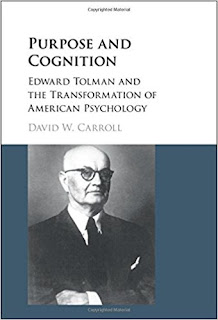
E.C. Tolman's Biography, and the end of PsychCritques

I recently completed what will be my last review for PsycCritiques, the online journal that succeeded the print Contemporary Psychology, which itself ran from 1956-2004 (founded by Edwin Boring). The book was a good one:

http://amzn.to/2zrqmnY

Wednesday, November 1, 2017

Restarting.... Again

There has been another prolonged absence on this blog, about 5 months this time. While a shame, at least that time has been productive. I completed a few projects and began a few more. It is time to restart things here.... again.

Later this week, I will start with a review of the recently published biography of E.C. Tolman.

After that, I will start reviewing articles from this year's Special Issues of the journal Ecological Psychology, which were dedicated to the 50th anniversary of Gibson's "The Senses Considered as Perceptual Systems." (They can be found here, and here.) That book was crucial because it was the first big statement about Gibosn's system, following only a small number of articles hinting about the direction his thinking was moving in. It is less read than his 1979 books, which is a shame, because in many ways it lays the system out better, including more in depth discussions about the physiology and evolution of sensory systems. I've skimmed some of the articles in the Special Issues, and there is some really impressive scholarship there; things that I hope will influence the field for many years to come, and which deserve to have influence beyond the field. Where I can, my focus will be on drawing out what I see as the larger morals in the articles, rather tan simply summarizing them.


Two additional things I hope to start working on: 1) Telling people a bit about my current job. 2) Sharing nifty announcements from the various societies I'm associated with.

With the latter in mind, it is worth noting that the journal History of Psychology has been promoting it's section reserved for not-full-length-article contributions to the field.


A reminder that the Sources, Research Notes, and News section of History of Psychology is a venue for publication of brief research notes, discussion of methodology, and reports on archives or sources. If you are interested in contributing something to this section please contact me.
Additionally, a plug for our  “News & Notes Poetry Corner,” which emphasizes the marginal, yet notably amusing, role of psychology-oriented poetics in the history of the field. If you’re “holding” any little known or much lauded poetic gems by or about psychologists or psychology, I invite you to send them along to be featured.

People interested in submitting to that should email  news.editor@historyofpsych.org


Wednesday, June 21, 2017

Ecological and Social Psychology - Is it Holt or Nothing?!?

My initial article connecting Holt and Ecological Psychology (see discussion here) generated two comments. The comments covered many points, but the most consistent thread was that Ecological Psychology had studied social behavior and had not needed to turn to Holt to do so. The journal (Integrative Psychological and Behavioral Science, IPBS) invited me to respond. Taking the strongest tact I could, the title of the reply focused on the main bone of contention: "Ecological Psychology and Social Psychology: It is Holt,or Nothing!" (full text available here). While that might have been a bit extreme, seven years later I still believe that if it overstepped, it was not by much. The central problem is that Ecological Psychology is fundamentally a theory of perception, while Social Psychology is fundamentally about how congregations of things with minds are different than collections of things without minds; for Ecological Psychology to truly contribute to Social Psychology, the assertion must be made, at some level, that we can perceive the things that make the interactions of things with minds interesting... we must, at some level, be able to perceive minds. As I set up in the text:

Monday, May 22, 2017

Ecological and Social Psychology - Starting to look back

I have a paper coming out in the next issue of Ecological Psychology. It is an article written for the 50th anniversary of Gibson's The Senses Considered as Perceptual Systems. The article lays out the foundation of Ecological Psychology, as I see it, the core insights of the field connected to Gibson's prescient insight regarding what an evolutionary theory of perception must look like. This logic was most well developed in the 1966 book, and because Gibson was not keen on repeating himself, those ideas were not drawn out to nearly the same extent in his later works. Finalizing that article has me thinking again about the relationship between ecological and social psychology.


A decade ago I started a dialog in Integrative Physiological and Behavioral Science about the relationship between Ecological Psychology and Social Psychology. It started as my first formal foray into connecting the work of E. B. Holt and J. J. Gibson, and ended up with three articles written by myself, three official comments, and a several articles (both in IPBS and in other venues) that referenced the discussion. My first article was very broad, but the replies focused the exchange on the more radical possibilities of an ecological-social psychology. The start of it al, the lead in for the first paper, was Holt's marvelous metaphor between a coral reef and the peril's of psychological reductionism (especially "bead-theory" approaches to psychology):

Monday, May 1, 2017

Bead Theory and the Problem of Consciousness - Continued

Continuing to unravel the problem of contrasting consciousness and behavior discussed in the prior post, Holt (1915). The influence on people like J.J. Gibson and Skinner continues to be evident, in the search for functional relations. This also connects to my assertion that the goal of William James's later work - and hence Holt's work - was to try to layout the foundational conditions for a science of psychology:


An exact definition of behavior will reveal this. Let us go about this definition. Behavior is, firstly, a process of release. The energy with which plants and animals move ('behave')  is not derived from the stimulus, but is physiologically stored energy previously accumulated by processes of assimilation. The stimulus simply touches off this energy.
Secondly, behavior is not a function of the immediate stimulus. There are cases, it is true, in which behavior is a function, though even here not a very simple function, of the stimulus. These are cases of behavior in its lower stages of development, where it is just emerging from the direct reflex process. They demonstrate the continuity of evolution at this point—a most important fact. But as behavior evolves, any correlation between it and the stimuli which are immediately affecting the organism becomes increasingly remote, so that even in fairly simple cases it can no longer be demonstrated.

Thursday, April 27, 2017

Bead Theory and the Problem of Consciousness - Highlights for Holt's writing


E.B. Holt 1915 book continues to be central to my scholarship. Appended to the book are two articles Holt had published the prior year, on "Response and Cognition." There is much overlap between the works, but in a few places I think the articles add significantly. One is in discussion of explanations that Holt disparagingly calls "Bead Theories", characterized by description of a series of events with no reference to the fact that a larger thing is happening. He begins by describing the how other sciences used to be in the same "unstable" state as psychology, and 100 years later, psychology seems to me not to have improved. Remember that a book published in 1915 must have been started quite a bit before Watson's Manifesto, and that this book was influential in the professional development of J.J. Gibson, B.F. Skinner, and J. Jastrow, along with most others who trained at Harvard in the teens or Princeton in the '30s. Indeed many core aspects of Gibson's Ecological Psychology, and Skinner's attempt to separate of "Psychological" questions from "Neurological" questions can be seen here decades earlier:


Before proceeding … we shall probably find useful an illustration from another science, which was once in the same unstable state of transition as psychology is now. In physics a theory of causation once prevailed, which tried to describe causal process in terms of successive ‘states,’ the ‘state’ of a body at one moment being the cause of its ‘state’ and position at the next. Thus the course of a falling body was described as a series of states (a, b, c, d, etc.), each one of which was the effect of the state preceding, and cause of the one next following. This may be designated as the ‘bead theory ' of causation. In asmuch, however, … [the states] gave no clue toward explaining the course or even the continuance of the process, an unobservable impetus (vis viva, Anstoss, ‘force') was postulated. This hidden impetus was said to be the ultimate secret of physical causation. But, alas, a secret! For it remained, just as the ‘consciousness’ of one's fellow-man remains today in psychology, utterly refractory to further investigation.

Tuesday, April 18, 2017

The problem with alternatives to cognitive psychology

In the last post, I pointed out the problem with cognitive psychology: While often hopelessly ambiguous, it creates a practical and useful sense of solidity, making it easy to use for normal professional activities. But what about alternative approaches?


Alas, the situation is almost the complete opposite for most attempts to get “beyond cognitivism”: They are not, or at least do not seem, useful in the above sense. They are not flexible, in that they are picky about which theoretical constructs are plugged into a given hole; they are not utilitarian, in that it is often unclear how to implement a program of research based on the theories, even if you agree with them completely; and they are non-conformist, in that they involve rejecting the way lay westerners think of the world. Further (or perhaps as a result), though the terms used might be quite concrete, they provide a firm illusion of being hopelessly ambiguous. The combination of little flexibility, little usefulness, unintuitiveness and seeming ambiguity, make it difficult for aspiring psychologists to understand, and further, once the neophytes become convinced, it will be difficult for them to go about standard professional activities. (p. 195)

Monday, April 3, 2017

The Probelm with Cognitive Psychology

Martin Dege and I shared an office for a year at Clark University. He was a grad student studying cultural psychology, I a post doc studying parent-infant interaction from an evolutionary and ecological perspective. Our work was not very similar, but we got along well, including collaborating on a paper. It was, technically, a comment on a target article, but we did our best to make it stand alone. The focus was on explaining why "alternative approaches" to psychology - alternatives to the cognitive paradigm - struggled so much. To make this more clear, I started the paper with as blunt a statement as I could about the bar set by the current paradigm. Here are the first 2 paragraphs, with a link to full manuscript at the bottom: