A blog about problems in the field of psychology and attempts to fix them.

Showing posts with label cognition. Show all posts

Sunday, April 8, 2018

Representation, Bee Dances, and Daniel Hutto

Dan Hutto, who does great philosophy of psychology work, recently gave an ENSO seminar titled Beyond Content: Explications, Motivations and Implications. 


This is the ENactive Seminars Online (ENSO), put together by Merek McGann and Mathew Egbert. Dan gives a solid overview of the players working today on whether cognition necessarily entails representation - and what on earth that might mean. For those who don't know, after championing a Wittgensteinian view of folk-psychology theories in the beginning of his career,  Dan has spent the last decade or so as one of the heavy hitters in philosophy arguing that cognition need not entail mental representation. Though he thinks representation has a place in the conversation - post language - he does not think "basic cognition" requires it at all.

Tuesday, November 7, 2017

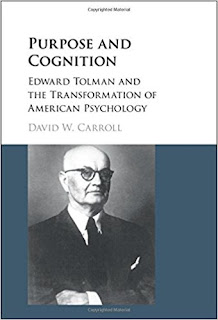
E.C. Tolman's Biography, and the end of PsychCritques

I recently completed what will be my last review for PsycCritiques, the online journal that succeeded the print Contemporary Psychology, which itself ran from 1956-2004 (founded by Edwin Boring). The book was a good one:

http://amzn.to/2zrqmnY

Wednesday, June 21, 2017

Ecological and Social Psychology - Is it Holt or Nothing?!?

My initial article connecting Holt and Ecological Psychology (see discussion here) generated two comments. The comments covered many points, but the most consistent thread was that Ecological Psychology had studied social behavior and had not needed to turn to Holt to do so. The journal (Integrative Psychological and Behavioral Science, IPBS) invited me to respond. Taking the strongest tact I could, the title of the reply focused on the main bone of contention: "Ecological Psychology and Social Psychology: It is Holt,or Nothing!" (full text available here). While that might have been a bit extreme, seven years later I still believe that if it overstepped, it was not by much. The central problem is that Ecological Psychology is fundamentally a theory of perception, while Social Psychology is fundamentally about how congregations of things with minds are different than collections of things without minds; for Ecological Psychology to truly contribute to Social Psychology, the assertion must be made, at some level, that we can perceive the things that make the interactions of things with minds interesting... we must, at some level, be able to perceive minds. As I set up in the text:

Monday, April 3, 2017

The Probelm with Cognitive Psychology

Martin Dege and I shared an office for a year at Clark University. He was a grad student studying cultural psychology, I a post doc studying parent-infant interaction from an evolutionary and ecological perspective. Our work was not very similar, but we got along well, including collaborating on a paper. It was, technically, a comment on a target article, but we did our best to make it stand alone. The focus was on explaining why "alternative approaches" to psychology - alternatives to the cognitive paradigm - struggled so much. To make this more clear, I started the paper with as blunt a statement as I could about the bar set by the current paradigm. Here are the first 2 paragraphs, with a link to full manuscript at the bottom:

Sunday, January 27, 2013

Pragmatism and Behaviorism: "Hypotheses"

Below is a quote from psychologist E. C. Tolman. It shows the clear influence of Pragmatist thinking on Radical Behaviorism. (Personally, I think it could be done better without reference to something "within the organism", but that is a minor point.)

------------


(2) But let us turn, now, to a brief consideration of the second main subtype of cognitive behavior-readiness, what I called hypotheses; or intentions, expectations and attainments as to relations. Suppose a rat be run in a successive discrimination box. Such a box is an apparatus in which the animal has to choose one of two doors at each of four successive choice points. One of the two doors at each such point is lighted and one is dark. The lighted door may be either the one on the left or the one on the right in chance order. Thus at each such point the animal has the possibility of responding either on the basis of light-darkness or on that of right-leftness. Suppose, now further, that it be arranged by the experimenter that the correct choices shall in a day's series of 10 trials, or 40 choices in all, fall an equal number of times to the left and an equal number of times to the right, and suppose it also be arranged that the correct door be an equal number of times a dark door and an equal number of times a lighted door. Under these conditions it was found by Krechevsky, whose experiments it is I am reporting, that the rat will pick up one systematic way of behaving after another. In the first two or three days he may pick up, say, the propensity of choosing always the right hand doors. But then he will shift sooner or later to some new propensity, to that say, of choosing only the left hand doors; and then still later to that of choosing alternate right and left doors; or he may shift to choosing all the lighted doors, irrespective of side, or all the dark doors, or to choosing alternately light and dark; and so on. Each such systematic propensity will be adopted for a time and then dropped in favor of some other. And, following Krechevsky, we may now define each such intervening condition (or "I") in the organism, behind any one such systematic way of behaving, as an hypothesis. An hypothesis, behavioristically, in other words, is to be defined as nothing more nor less than a condition in the organism which, while it lasts, produces just such a systematic selectivity in behavior. Further, it appears that such an hypothesis or selectivity is equivalent to an intention or assertion of a specific relation as obtaining in the environment. In the above case these assertions are to the effect that it is such and such types of door which lead on and such and such other types which are closed. The rats assert-hypothesize-that it is the right hand doors, or the left hand doors, or alternate right and left doors or dark doors, or whatever, which, as such, lead on. And when any one such assertion proves incorrect, an animal sooner or later drops it for a new one.

In the experiment as thus far described, the problem given to the animals was actually insoluble. The correct doors were, that is, determined by chance. And no hypotheses--none of the systematic selectivities in the behaviors of the animals-could prove successful. This meant that during the entire duration of the experiment the rats kept shifting from one hypothesis to another. In other experiments, however, the situation was different. Thus in one case it was arranged that after a rat had once adopted some hypothesis with a given degree of consistency the experimenter then made that hypothesis correct. Under these conditions the animals persisted in their now correct hypothesis throughout the entire remainder of the investigation. Or, again in still another set-up, a certain hypothesis was made correct from the very beginning. In such a case the rats might begin with various wrong hypotheses. But they always ended sooner or later with the single correct one. So much for rats, let us turn now to human beings….

Tuesday, November 27, 2012

Mind-Body Dualism is Bad for your Health!

Hey, you know all that pop-psych BS coming out of positive psychology and similar movements? Things like: "Try forgiveness, your cholesterol level will thank you!"*

Thanks to the good people at Psychological Science, I finally found a result I can support! October's issue brought us: "The mind is willing, but the flesh is week": The effects of mind-body dualism on health behavior by Forstmann, Burgmer, & Mussweiler from the University of Cologne. This clever little study found out that being a mind-body dualist is actually bad for your health. This is great! No more bothering with logical arguments or historic discussions, no more focus on incoherence, no more two part posts. You should all stop being dualist because it will make you gain weight and die young. Problem solved. And this isn't a all a joke, their methods were pretty clever, and the results pretty clear. The researchers start with a simple hypothesis:
Specifically, we hypothesized that the more people perceive their minds and bodies to be distinct entities, the less they engage in behaviors that protect their bodies.
In testing this hypothesis, they present six studies, with a few hundred participants between them. It all went something like this:

Tuesday, January 24, 2012

Theory of Mind and Radical Behaviorism

"Theory of Mind" has been one of the hottest topics in philosophical psychology and developmental psychology for the last 25 years. There are occasional ripples of interest in research at the intersection of ToM and comparative psychology, including a recent ripple generated by the release of a documentary "Project Nim". The documentary covers the story of Nim Chimpsky, who was part of a multi-decade study lead by Herb Terrace, intended to illuminate chimpanzee's linguistic abilities. The documentary focuses on ethical issues and on the narrative story arc of Nim's life. Herb has complained that the documentary under-emphasizes the scientific side of Nim's story --- which they the director interviewed him about extensively, then cut --- and has been attempting to remind people about the scientific importance of the study, emphasizing:
Nim’s inability to learn a language deepened our understanding of the basic difference between human and ape minds. Most important, apes lack a “theory of mind” – the ability to perceive what another ape is thinking.

Thursday, August 18, 2011

The Myth of Knowledge

Spurred by Sabrina's comment on my first post, and some of the things I have been writing about on Gary's blog "Minds and Brains", I wanted to talk a little bit about the Myth of Knowledge. This is an intense vestige of dualism, and of enlightenment philosophy. The modern notion of Knowledge is a brilliant 18th and 19th century idea, which is just plain wrong. I'm a big fan of anachronistic ideas like this - the great chain of being, intelligence, etc. - but they are hypotheses that are false, and they are now interfering with our building a more coherent psychology.

The Myth of Knowledge 

Once upon a time it was believed that one of the most basic psychological kinds was 'knowledge', i.e., a person 'knowing' something. Well, not a person, but a mind. The body sits there, but the mind/soul/spirit knows things. Several hundred years of philosophy (from at least Descartes on) started with epistemology, i.e., started with a knower and with things known. But what is it to know something?