A blog about problems in the field of psychology and attempts to fix them.

Showing posts with label cognitive psychology. Show all posts

Sunday, April 8, 2018

Representation, Bee Dances, and Daniel Hutto

Dan Hutto, who does great philosophy of psychology work, recently gave an ENSO seminar titled Beyond Content: Explications, Motivations and Implications


This is the ENactive Seminars Online (ENSO), put together by Merek McGann and Mathew Egbert. Dan gives a solid overview of the players working today on whether cognition necessarily entails representation - and what on earth that might mean. For those who don't know, after championing a Wittgensteinian view of folk-psychology theories in the beginning of his career,  Dan has spent the last decade or so as one of the heavy hitters in philosophy arguing that cognition need not entail mental representation. Though he thinks representation has a place in the conversation - post language - he does not think "basic cognition" requires it at all.

Tuesday, November 7, 2017

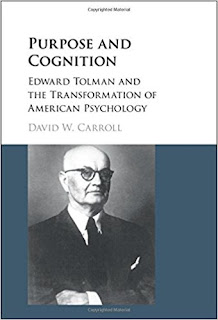
E.C. Tolman's Biography, and the end of PsychCritques

I recently completed what will be my last review for PsycCritiques, the online journal that succeeded the print Contemporary Psychology, which itself ran from 1956-2004 (founded by Edwin Boring). The book was a good one:

http://amzn.to/2zrqmnY

Thursday, April 27, 2017

Bead Theory and the Problem of Consciousness - Highlights for Holt's writing


E.B. Holt 1915 book continues to be central to my scholarship. Appended to the book are two articles Holt had published the prior year, on "Response and Cognition." There is much overlap between the works, but in a few places I think the articles add significantly. One is in discussion of explanations that Holt disparagingly calls "Bead Theories", characterized by description of a series of events with no reference to the fact that a larger thing is happening. He begins by describing the how other sciences used to be in the same "unstable" state as psychology, and 100 years later, psychology seems to me not to have improved. Remember that a book published in 1915 must have been started quite a bit before Watson's Manifesto, and that this book was influential in the professional development of J.J. Gibson, B.F. Skinner, and J. Jastrow, along with most others who trained at Harvard in the teens or Princeton in the '30s. Indeed many core aspects of Gibson's Ecological Psychology, and Skinner's attempt to separate of "Psychological" questions from "Neurological" questions can be seen here decades earlier:


Before proceeding … we shall probably find useful an illustration from another science, which was once in the same unstable state of transition as psychology is now. In physics a theory of causation once prevailed, which tried to describe causal process in terms of successive ‘states,’ the ‘state’ of a body at one moment being the cause of its ‘state’ and position at the next. Thus the course of a falling body was described as a series of states (a, b, c, d, etc.), each one of which was the effect of the state preceding, and cause of the one next following. This may be designated as the ‘bead theory ' of causation. In asmuch, however, … [the states] gave no clue toward explaining the course or even the continuance of the process, an unobservable impetus (vis viva, Anstoss, ‘force') was postulated. This hidden impetus was said to be the ultimate secret of physical causation. But, alas, a secret! For it remained, just as the ‘consciousness’ of one's fellow-man remains today in psychology, utterly refractory to further investigation.

Tuesday, April 18, 2017

The problem with alternatives to cognitive psychology

In the last post, I pointed out the problem with cognitive psychology: While often hopelessly ambiguous, it creates a practical and useful sense of solidity, making it easy to use for normal professional activities. But what about alternative approaches?


Alas, the situation is almost the complete opposite for most attempts to get “beyond cognitivism”: They are not, or at least do not seem, useful in the above sense. They are not flexible, in that they are picky about which theoretical constructs are plugged into a given hole; they are not utilitarian, in that it is often unclear how to implement a program of research based on the theories, even if you agree with them completely; and they are non-conformist, in that they involve rejecting the way lay westerners think of the world. Further (or perhaps as a result), though the terms used might be quite concrete, they provide a firm illusion of being hopelessly ambiguous. The combination of little flexibility, little usefulness, unintuitiveness and seeming ambiguity, make it difficult for aspiring psychologists to understand, and further, once the neophytes become convinced, it will be difficult for them to go about standard professional activities. (p. 195)

Monday, April 3, 2017

The Probelm with Cognitive Psychology

Martin Dege and I shared an office for a year at Clark University. He was a grad student studying cultural psychology, I a post doc studying parent-infant interaction from an evolutionary and ecological perspective. Our work was not very similar, but we got along well, including collaborating on a paper. It was, technically, a comment on a target article, but we did our best to make it stand alone. The focus was on explaining why "alternative approaches" to psychology - alternatives to the cognitive paradigm - struggled so much. To make this more clear, I started the paper with as blunt a statement as I could about the bar set by the current paradigm. Here are the first 2 paragraphs, with a link to full manuscript at the bottom:

Saturday, December 22, 2012

You don't know what you want!

Sometimes discussion on other people's blog get so big, it is time to move at least part to another location. Neuroskeptic had a great post about the trap of extreme scientism, which combines the ideas that A) science can solve all problems and that B) one should not act except based on scientific evidence. The post is "My Breakfast With Scientism", and it starts with a man trying to determine which of two cereals he wants to eat. He realizes he needs some scientific evidence to determine which he should eat.... and things get much, much worse from there. Because an over-worship of science involves significant skepticism of normally routine claims and decisions, you end up in a very similar place to Descartes's over-worship of rationalism. You know:
Hey Descartes! You claim you are doubting everything.... but how can you be sure? }:- P
The comments on Neuro's post got into some really interesting ground that seems more appropriate for this blog... so I'm moving it over here. In particular, a commenter named "DS" asserted that "what he wants" is a scientifically admissible fact of the highest caliber. It isn't. But explaining why is can be difficult....

Monday, December 10, 2012

Neuroskeptic Part 1 - Misunderstanding Neursocience

For those who don't know, Neuroskeptic is one of the more popular science bloggers in the world. He is a research-active British neuroscientist, who has been highlighting important findings, and criticizing public (and professional) misunderstandings of those findings for several years. He does this anonymously, and even the people in his home department do not know his identity. His blog-icon is what initially appears to be a stupid picture of a disembodied brain with two eye balls; though that is closer to what he looks like than you might think.

I'm going to assume he will be posting about his talk in the near future, but before he gets a chance, I'm going to scoop him a bit, at least by discussing what I thought was the highlight of his talk. The talk was in Philadelphia, at the University of Pennsylvania's Center for Neuroscience and Society. It was worth the drive to listen to the talk and get to shake his hand, because once I had wiped the cerebral spinal fluid off with a wet-nap, our discussions covered many topics (hence the "Part 1" for this post). For now, I'll stick to discussing his formal talk, starting with a picture of the talk in progress:

Thursday, August 18, 2011

The Myth of Knowledge

Spurred by Sabrina's comment on my first post, and some of the things I have been writing about on Gary's blog "Minds and Brains", I wanted to talk a little bit about the Myth of Knowledge. This is an intense vestige of dualism, and of enlightenment philosophy. The modern notion of Knowledge is a brilliant 18th and 19th century idea, which is just plain wrong. I'm a big fan of anachronistic ideas like this - the great chain of being, intelligence, etc. - but they are hypotheses that are false, and they are now interfering with our building a more coherent psychology.

The Myth of Knowledge 

Once upon a time it was believed that one of the most basic psychological kinds was 'knowledge', i.e., a person 'knowing' something. Well, not a person, but a mind. The body sits there, but the mind/soul/spirit knows things. Several hundred years of philosophy (from at least Descartes on) started with epistemology, i.e., started with a knower and with things known. But what is it to know something?